3 Jun 2009

When they were Young

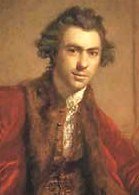
Archelaus, my hero, is 19 in 1720, the year that Pullen is set. The illegitimate child of a nobleman and a theatrical performer, Archie has never met his father, who dies shortly after the novel opens.

As I want him to gradually develop enough feeling for this man he's never known to want to avenge his death, it is important that he gain some sense of him. So in the course of visiting an old friend of his father's, Archie will see a set of miniatures painted in about 1676, when his father would himself have been nineteen - and on the Grand Tour with his friend Ervin.

It was customary for young men to have themselves depicted in full classical antic mode, with ruined columns, rent curtains, toga-type gowns and bits of armour. I wouldn't imagine - no matter what the skill of that year's modish artist - that it was always easy to make a young man look good like this:

(Nicholaes Maes, Portrait of a Young Man, 1676)

But for every ten chaps who looked a bit burkish, there was always one who managed to look cool no matter what get-up he was shown in:

(Unknown artist, John Wilmot, 2nd Earl of Rochester, c. 1665-75)

Archie, who is not immune to a bit of vanity, will have his first throb of fellow-feeling for his father when he sees how much they are alike.

2 Jun 2009

Tell it to the Bees

It's not often that I descend from the 18thC to the present day, but even I'm willing to make the trip for my friend Fiona's latest novel (her fourth) - Tell it to the Bees (publ. Tindal Street).

Told through the eyes of a young boy, Charlie, growing up in the 1950s, it is the story of the dissolution of a marriage and development of a love. It is subtly and gently told, and utterly gripping. I read it in two sittings.

If you've just finished a book or are looking for a present for someone else, I couldn't recommend it highly enough if it were my own!


30 May 2009

Sarah Churchill on the Credit Crunch:


Among those who sold their shares in the South Sea Co. and made a killing before it all went chalk-outline-of-banker-on-the-pavement shaped, was Sarah Churchill (née Jenyns), Duchess of Marlborough.

Her Duke, the victor of Blenheim, Ramillies, Oudenarde and Malplaquet, may, as she reported, have on his return "pleasured her twice in his top boots", but financially she wore the trousers. It was she who built Blenheim palace and its grounds, and amassed a vast and lasting fortune.

Her punditry is as pertinent today as it was in 1720:

"Every mortal that has common sense or that knows anything of figures, sees that 'tis not possible by all the arts and tricks upon earth long to carry £400,000,000 of paper credit with £15,000,000 of specie. This makes me think that this project must burst in a little while and fall to nothing."

29 May 2009

Scandal-broth: Tea


Might it be for more than Fashion, that the lovely Mrs. H-- H-- H-- has recently shown herself so taken by her new Turban-Hat, from which neither Sun, Rain nor ingallant Breezes can part her?

We have heard that her Attachment to the outlandish Headgear is due to an unfortunate Circumstance - the lady has lost the Wealth of lustrous Curls for which she was rightly famed. Nature is not to be upgraded for this barbarity, however; but rather Mammon.

Her husband, whose debts to Dame Fortune and the Beauties of the Bagnio have made the name H-- H-- a Byword for bad Credit, deserves some degree of Censure. His Lady found it necessary to offer her Tresses on the open Market in order to have anything to serve their Guests at a forthcoming Party.

27 May 2009

Swift on the Credit Crunch:

..."How will the caitiff wretch be scared
When first he finds himself awake
At the last trumpet, unprepared,
And all his grand account to make!

For in that universal call,
Few bankers will to Heav'n be mounters:
They'll cry, 'Ye shops, upon us fall!
Conceal and cover us, ye counters.'"

Jonathan Swift, The Run upon the Bankers (repr. 1720)

St. James's Street

Nip through the Park and do a quick dog-leg by way of Spring Garden (an alley), Cockspur, Warwick Street and Pall Mall, and you would find yourself in St. James's Street.

Here you could enjoy the company of the gentle sex (for a price) at the Bagnio at number 63. Next door were Fenton's Hotel and the Cocoa Tree coffee shop (no. 64) which catered to the Tory MPs. The Whigs used the St. James coffee house just up the road at number 60.

White's Chocolate House at number 28 had a gaming room for gamblers, next door to Mrs. Hannah Humphrey's bookshop at no. 27.

22 May 2009

Sedan Chair - part one


A Modern Belle going to the Rooms at Bath
James Gillray (1796)

21 May 2009

Perspective

I never saw an ugly thing in my life; for let the form of an object be what it may - light, shade and perspective will always make it beautiful.

John Constable

19 May 2009

The Bruiser's Reply

Churchill wrote in reply:

Be wicked as thou wilt; do all that's base;
Proclaim thyself the monster of thy race.
Let Vice and Folly thy black soul divide;
Be proud with meanness, and be mean with pride.


I think it's fair to say that he felt stung.

The Bruiser

THE BRUISER, C. CHURCHILL (once the Rev'd!) in the Character of a Russian Hercules. Regaling himself after having Kill'd the Monster Caricaturea that so sorely Gall'd his Virtuous friend, the Heaven born WILKES!

But he had a Club this Dragon to Drub, or he had ne'er don'it, I warrant ye --- Dragon of Wantley

Designed and Engraved by Wm Hogarth Price 1s 6d n Publish'd according to act of Parliament August 1. 1763


Hogarth - depicting himself here in the foreground, in the character of his own pug-dog - is ridiculing the satirist, critic and poet, Charles Churchill (ally of the radical politician John Wilkes, who Hogarth considered an enemy).

8 May 2009

Mr. Johnston's Bear

I called at Drury Lane Playhouse for Mr. Garrick... In the theatre there was a fine large dog chained. "This," said he, "is Johnston the boxkeeper's bear, though I don't know which of 'em is the greatest bear."

4 May 2009

Johnson on the Credit Crunch:

"Trade may make a man rich; but riches, without goodness, cannot make us happy."

A child of older parents:

...'leads much the same sort of life as a child's dog; teased like that with fondness through folly, and exhibited like that to every company, through idle and empty vanity.'

[Sam Johnson, who suffered from his parents' attention]

1 May 2009

A Proper Spectacle


(Lifted from a Hogarth crowd-scene).

Boswell on the Credit Crunch:

...'I now made a very clear calculation of my expenses for the year, and found that I would be able to save £50 out of my allowance... Not satisfied with saving £50, I went to work still nearer, wishing to save £20 more, and with great thought and assiduity did I compute. In short, I found myself turning very fond of money and ruminating with a kind of transport on the idea of being worth £70 at the year's end. The desire of being esteemed a clever economist was no doubt mixed in with it, but I seriously think that sheer love of coin was my predominant principle...
I have observed in some preceding period of this my journal that making money is one of the greatest pleasures in life, as it is very lasting and is continually increasing. But it must be observed that a great share of anxiety is the constant concomitant of this passion, so that the mind is as much hurt in one way as it is pleased in another... To keep the golden mean between stinginess and prodigality is the point I should aim at.'

James Boswell, 9 February 1763

15 Apr 2009

Coves, Kinchins and Morts

COVE - A man, a fellow, a rogue. The cove was bit: the rogue was outwitted. The cove has bit the cole: the rogue has got the money.

KINCHIN - A little child. Kinchin coes: orphan beggar boys, educated in thieving. Kinchin morts: young girls under the like circumstances and training. Kinchin morts, or coes in slates: beggars' children carried at their mothers' backs in sheets. Kinchin cove: a little man.

MORT - A woman or wench; also a yeoman's daughter. To be taken all a-mort: to be confounded, surprised or motionless through fear.

SLATE - A sheet.

From Francis Grose's dictionary The Vulgar Tongue (1785).


Cant, the argot which Grose catalogues, was the language of street-traders, criminals and itinerants: a language of self-protection for those planning or committing illicit acts, or wishing to have private discourse in public; it also acted as a badge of identity of the marginal or dispossessed.

13 Apr 2009

Dangerous Beauty

Continuing musings on toxic cosmetics...

What is amazing to me, is that the Georgian beauties knew what they were risking in applying ceruse directly onto their skin - and that was just for starters, the white lead 'base coat' - even without a legion of scientists and rodents to guinea-pig for them. Common gossip alleged that a number of women had died from 'addiction' to various dangerous tints: in his correspondence, Horace Walpole mentions Lady Fortrose, ‘killed like Lady Coventry and others by white lead, of which nothing could break her’, even though ceruse was known to be ‘corrosive and pernicious to the skin.’ As late as 1822 The British Perfumer warned of the high toxicity of vermilion, recommending the use of less harmful cochineal papers for applying rouge instead.

But are we any better today? Our Hollywood belles inject poison into their flesh in Botox, which magazines and tube adverts attempt to incite us to also try over a lunch-time sandwich. It's becoming ever-more common for 'ordinary' people to have bits of our faces augmented or our skin stretched tauter, bags of silicone deposited in our bodies, and inches of fat sucked away.

And, again just as today when we collude with artificiality - to some extent indulging ourselves, by persisting in feeling inferior to magazine images which we know are airbrushed - so George Romney, John Hoppner, Richard Westall, Richard Cosway, etc. were all even at the time known to flatter the (already excessively made-up) women who sat for them by further 'improving' their complexions...

9 Apr 2009

Popular Drinks of the Georgian Era...

ii: Hum Cap, or Hum

Very old and strong beer, often made with malt, such as Double Ale, Stout or Pharaoh; also known as STINGO.

8 Apr 2009

Kinchin morts...


... or, coves in slates :--

Beggars' children, carried on their mothers' backs,
bound up in sheets.


7 Apr 2009

Imagination Running Riot:

'If once our carnal appetites are let loose, without those prudent and secure guides [of virtue and religion], there is no excess and disorder which they are not liable to commit, even while they pursure their natural satisfaction; and, which may seem still more strange, there is nothing monstrous and unnatural, which they are not capable of inventing, nothing so brutal and shocking which they have not actually committed.'
Henry Fielding, The Female Husband (1746)